

Abstract
Deep learning methods based on backward stochastic differential equations (BSDEs) have emerged as competitive alternatives to physics-informed neural networks (PINNs) for solving high-dimensional partial differential equations (PDEs). By leveraging probabilistic representations, BSDE approaches can avoid the curse of dimensionality and often admit second-order-free training objectives that do not require explicit Hessian evaluations. It has recently been established that the commonly used Euler–Maruyama (EM) time discretization induces an intrinsic bias in BSDE training losses. While high-order schemes such as Heun can fully eliminate this bias, such schemes re-introduce second-order spatial derivatives and incur substantial computational overhead. In this work, we provide a principled analysis of EM-induced loss bias and propose an unbiased, second-order-free training framework that preserves the computational advantages of BSDE methods.
Computational Efficiency
Our method maintains a substantially lower computational cost compared to fully unbiased baselines, achieving training times nearly identical to the standard biased EM-BSDE.
| Method | Unbiased | 2nd-order-free | Time |
|---|---|---|---|
| EM-BSDE (Raissi et al., 2024) | 1x | ||
| Shotgun (Xu et al., 2025) | 0.75x | ||
| Multi-Shot EM-BSDE | 1.74x | ||
| Heun-BSDE (Park et al., 2025) | 42.91x | ||
| FS-PINNs (Park et al., 2025) | 32.07x | ||
| Un-EM-BSDE (ours) | 1.79x |
Unbiasedness
The standard EM-BSDE Loss, derived from Itô's formula, inherently introduces Bias because the expectation is taken after the squaring operation:
The Issue: Due to the property of the squared term, the variance of the approximation error acts as a non-vanishing bias, which can hinder the network from converging to the true solution.
Our Approach: Un-EM-BSDE Loss
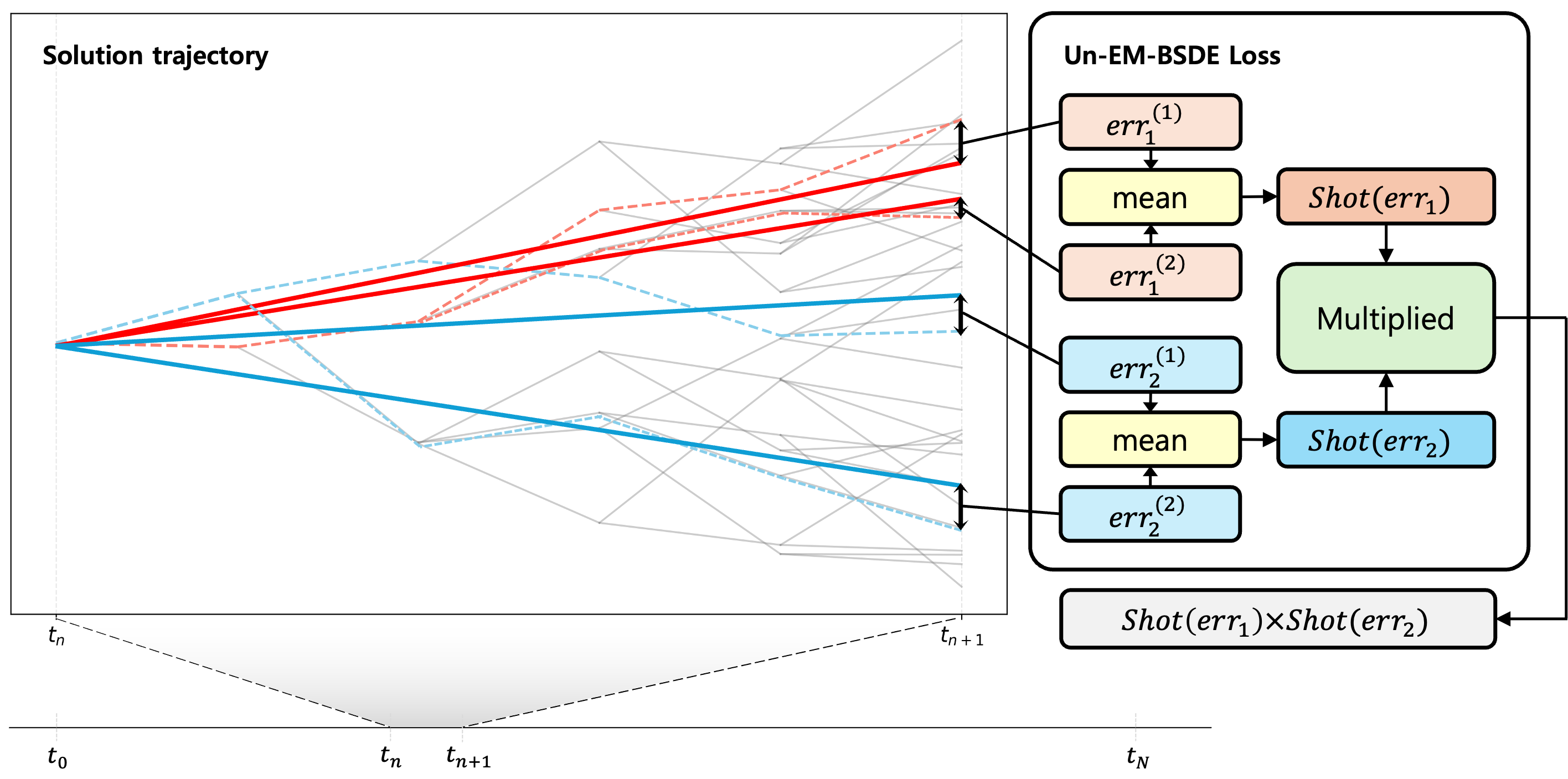
To eliminate this systematic error, we employ an Unbiased Estimator that effectively decouples the stochastic terms:
Instead of squaring a single realization, we calculate the product of errors from two independent sample groups (\(M_{1}, M_{2}\)). This ensures that the expectation of the product remains unbiased, removing the variance-induced noise from the optimization landscape.
Runtime vs. Accuracy
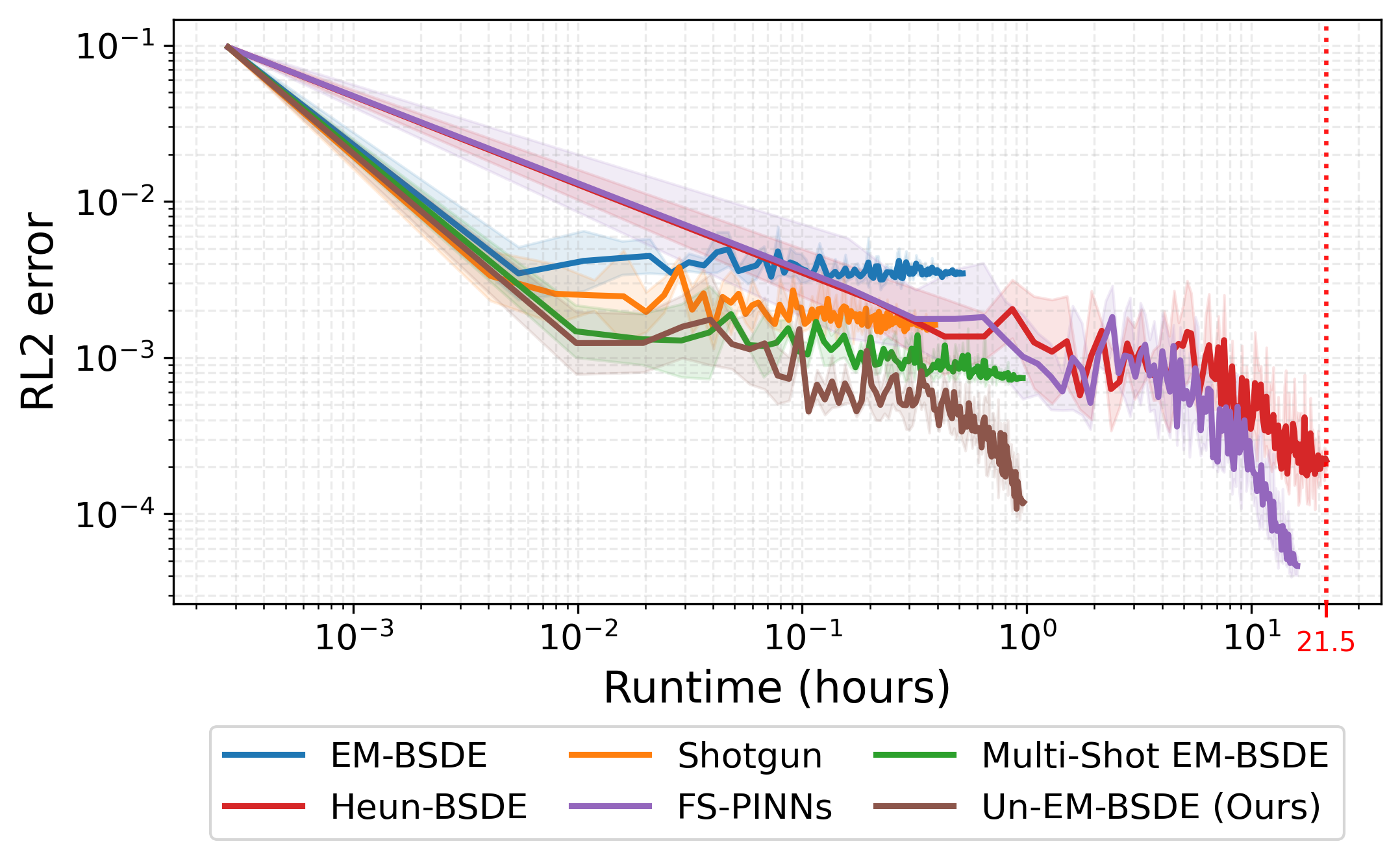
As shown in the runtime-accuracy plot below, baseline methods take a significantly long time to converge. In contrast, Un-EM-BSDE achieves high accuracy rapidly, vastly outperforming the others in terms of efficiency.
HJB Path Prediction
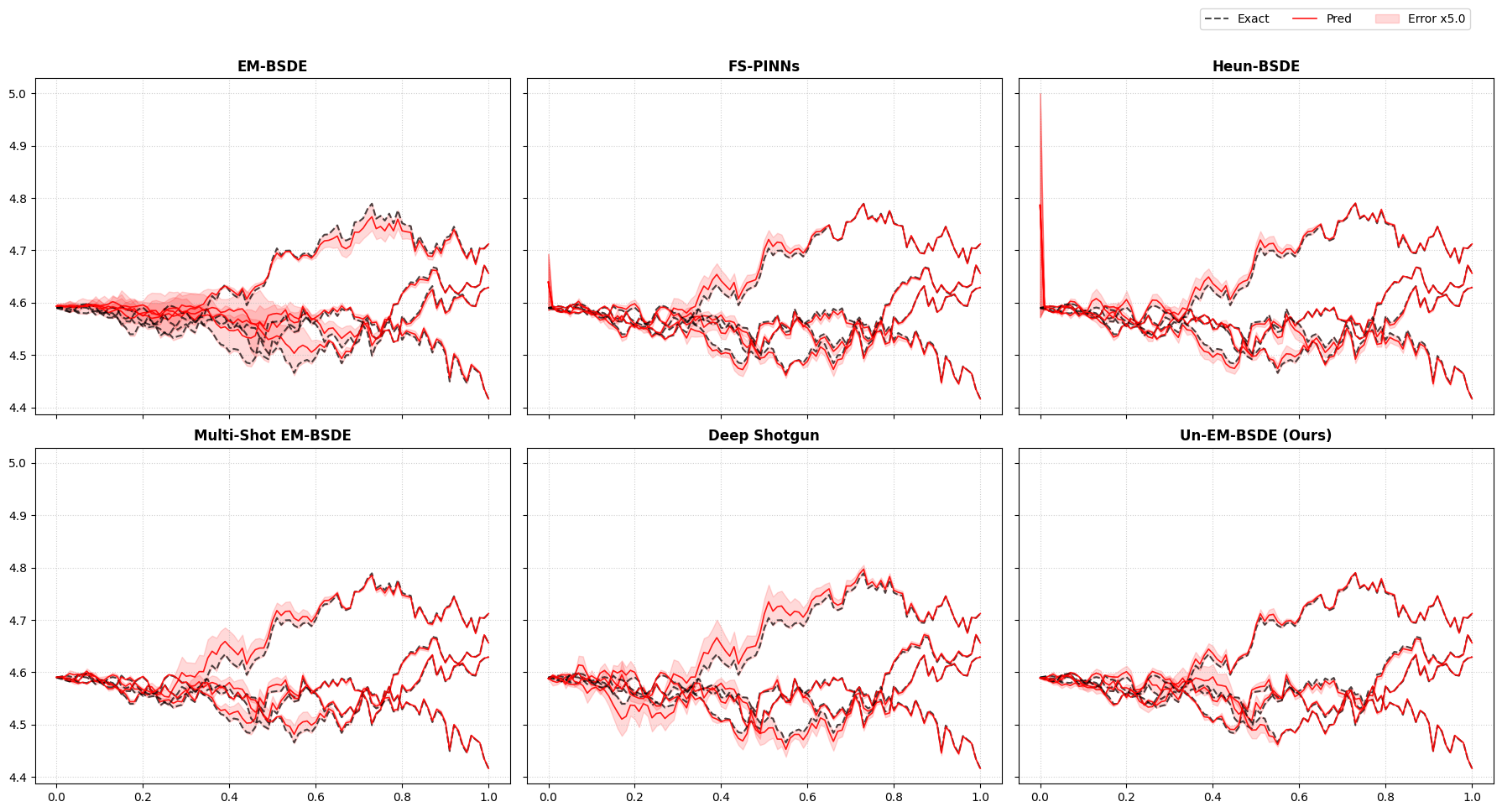
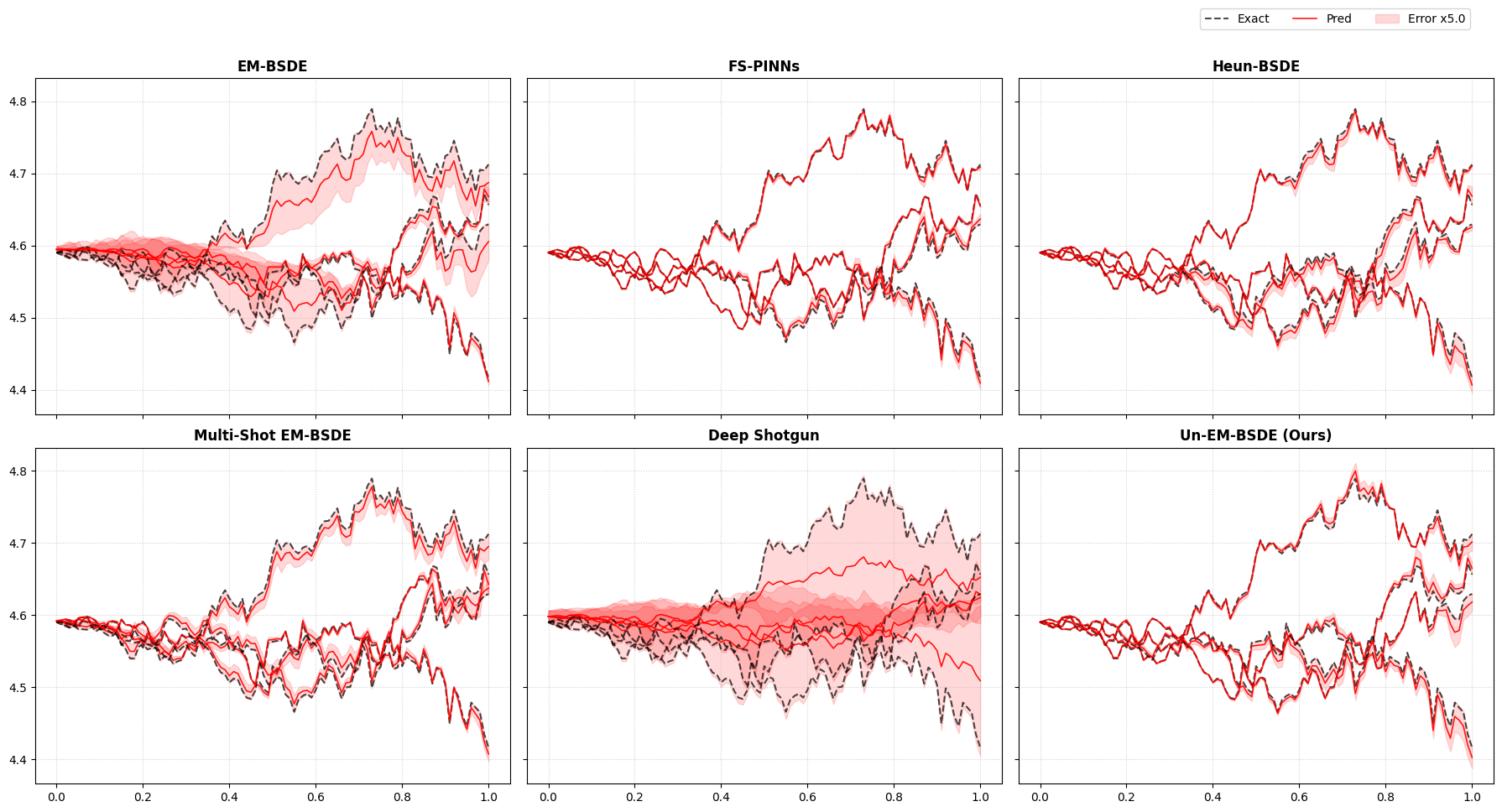
Visualizing the errors in the Hamilton-Jacobi-Bellman (HJB) equation demonstrates the superior precision of our methodology. The error bands remain remarkably tight across both hard and soft constraint settings.
BibTeX
@article{seo2026unbiased,
          title={Unbiased and Second-Order-Free Training for High-Dimensional PDEs},
          author={Seo, Jaemin and Lee, Surin and Lee, Jae Yong},
          journal={arXiv preprint arXiv:2605.14643},
          year={2026}
        }